Loading...
Junior ADU Conversions — Bay Area & San Mateo County
Junior ADU Conversions Across San Mateo County — Permitted, Classified Correctly, Built In-House
Bark & Build Builders converts interior rooms into legally classified Junior ADUs across San Mateo County. We handle the classification review, efficiency kitchen design, owner-occupancy deed restriction, and full construction under CA License #1119304 — submitting plans that match the JADU permit pathway from the start so your project doesn't get stuck in plan check revision cycles.
CSLB #1119304
500 sq ft Max
6–14 Week Permit Path
AB 1154 Compliant Design

The Core Distinction
A Junior ADU Is a Distinct Legal Unit — Not Just a Converted Bedroom
A Junior ADU (JADU) is a dwelling unit of no more than 500 square feet created entirely within the existing walls of a single-family home.
It is legally distinct from a standard ADU — different size cap, different kitchen requirements, different owner-occupancy rules, and different permit pathway. San Mateo County homeowners who begin the conversion process without understanding those distinctions often submit plans that require revision or face permit delays. Here's what separates the two before a single permit gets filed.
| Feature | Standard ADU | Junior ADU (JADU) |
|---|---|---|
| Location | Detached, attached, or above garage | Within existing home walls only |
| Max Size | Up to 1,200 sq ft (varies by jurisdiction) | 500 sq ft maximum |
| Kitchen Type | Full kitchen permitted | Efficiency kitchen required |
| Separate Entrance | Required | Required — plus interior access to main home |
| Owner-Occupancy | Not required in most Bay Area jurisdictions through 2025 | Required — unless AB 1154 exemption applies (see below) |
| New Construction | Allowed | Not allowed — conversion of existing space only |
That interior access provision — the requirement that the JADU maintain a connecting doorway to the main home even with its own exterior entrance — catches many plans by surprise. Bark & Build addresses it in the initial design package, not at the plan check revision stage. For projects that exceed the JADU footprint or require new construction, we also offer detached ADU construction in Redwood City as a separate pathway when the project scope calls for it. If your project falls outside the JADU classification entirely — such as converting a garage or building an attached addition — we also handle garage conversion and attached ADU options throughout San Mateo County.
JADU Terminology Quick Reference
The Terms That Determine Whether Your Permit Issues on the First Check
JADU permitting has loaded terminology. Most plan check rejections trace back to a misunderstood definition in the original submittal. These are the terms we work with on every project.
Efficiency Kitchen
Compact sink, plug-in cooktop (no hard-wired range), counter space, and minimal cabinetry. The legal threshold that keeps the unit classified as a JADU rather than a standard ADU.
Interior Access Provision
A required doorway connecting the JADU to the main home, even if the JADU has its own independent exterior entrance. Frequently missed in first-submission plans.
Owner-Occupancy Deed Restriction
A legal document recorded against the property title requiring the owner to live in either the primary residence or the JADU. Required at JADU permit application or issuance depending on jurisdiction.
AB 1154 Exemption
California legislation taking full effect in 2026 that exempts JADUs with their own independent bathroom from the owner-occupancy requirement — unlocking dual-tenant rental flexibility.
Drain Stack
The vertical waste pipe running through the home's floor framing. Its position determines how much flexibility you have in placing the efficiency kitchen sink without major plumbing rerouting.
Fire-Rated Partition Wall
A one-hour fire-rated wall assembly separating the JADU from the primary residence. Required by code; built with Type X drywall and properly sealed penetrations.


Permit Pathway
San Mateo County JADU Rules Have Real Teeth Across Local Jurisdictions
San Mateo County's JADU permit pathway moves efficiently when the classification is right from the start.
The plan check process for a JADU is often faster than for a standard ADU — but only when the submitted documents correctly identify the unit as a JADU and include the required owner-occupancy documentation upfront.
San Mateo County jurisdictions — including Redwood City, Menlo Park, and San Mateo — each apply the state JADU framework with minor local variations. Efficiency kitchen specifications, the interior access provision requirement, and deed restriction language differ slightly across city boundaries. Bark & Build manages junior ADU conversions throughout San Mateo County and submits plans to the correct local jurisdiction with the right documentation set already assembled.
That means fewer revision cycles and a faster path to permit issuance — typically 6 to 14 weeks from submission to issued permit.

Case Study — Encinal Avenue, Menlo Park
How a Kitchen Specification Error Nearly Cost One Homeowner Two Months
A 1960s ranch-style home near Encinal Avenue. Plans already paid for. About 420 square feet of interior space ready for conversion. On paper, it looked straightforward — until the permit pathway didn't match what the drawings actually showed.
From the Field
The Misclassified Kitchen That Would Have Bounced the Plan Check
I walked a property in Menlo Park where the homeowner had already paid a design firm to draw plans for a junior ADU conversion. The space was a large bedroom with an attached sitting room — about 420 square feet total. Some homeowners in this situation also explore whole-home remodeling alongside a JADU conversion to address aging finishes or layout changes in the primary residence at the same time.
When I reviewed the plans, I noticed the design had misspecified the kitchen scope. The drawings showed a full-size range and a dishwasher. Including a full-size range pushed the kitchen definition into standard ADU territory under that jurisdiction's code — a distinction that matters because the permit pathway, fee schedule, and owner-occupancy requirements all change when the unit is no longer classified as a JADU.
The interior access provision was drawn as a pocket door described in the notes as "lockable from both sides," which wouldn't satisfy the interior access requirement under applicable local code. The owner-occupancy documentation section of the permit application was blank.
We corrected the kitchen specification to a JADU-compliant efficiency kitchen with a plug-in induction cooktop and compact sink, fixed the interior access language, and prepared the owner-occupancy deed restriction documentation before submission. The permit issued on the first check — the outcome that correctly scoped documentation produces.
That's the difference between submitting plans that match the permit pathway and submitting plans that match the designer's assumption about it.

Documentation Discipline
Owner-Occupancy Documentation Is Handled Before Submission — Not After
Owner-occupancy is a condition of JADU permits, and the documentation needs to be part of the initial submittal package.
The owner-occupancy requirement means that whoever owns the property must live in either the primary residence or the junior ADU as their primary home. This gets recorded as a deed restriction — a legal document attached to the property title. Some permit offices require this document at the time of application. Others require it at permit issuance.
Bark & Build prepares the deed restriction language and the owner-occupancy declaration as part of every JADU permit submission. We include it in the initial package. Including it upfront removes a common hold at the plan check counter that adds time to the permit timeline. Our San Mateo County construction team has submitted JADU permit packages across every local jurisdiction in the county and is familiar with each office's specific documentation requirements.
If your circumstances change after the JADU is permitted, there are legal processes for modifying or releasing that restriction. That's a conversation for your real estate attorney. Our role is to make sure the documentation is complete and correctly formatted at the time of permit submission.

AB 1154 — Owner-Occupancy Exemption
When You Can Skip the Owner-Occupancy Requirement Entirely
Assembly Bill 1154, taking full effect in 2026, changes the owner-occupancy calculus for JADUs with independent bathrooms.
For years, the strict owner-occupancy mandate was the largest planning variable for JADU homeowners. If you built a JADU, the property owner was required to reside in either the primary dwelling or the newly created unit. Under AB 1154, that requirement is exempted when the JADU is designed with its own independent bathroom. If the unit shares sanitation facilities with the primary house, the owner-occupancy rule still applies.
We design JADU floor plans to include a dedicated, private bathroom whenever the budget and floor plan allow — fully unlocking the AB 1154 exemption. This means you can rent out both the primary house and the JADU simultaneously to two different tenants, turning your single-family property into a dual-income asset with full regulatory flexibility.
The tradeoff is upfront cost. A private bathroom typically adds $15K–$30K depending on whether the existing drain stack can be tapped or new waste lines need to be trenched into the slab. We model the math both ways and explain the rental flexibility difference during the feasibility phase so you can decide what makes sense for your property.
Acoustic Privacy
How We Build Partition Walls That Actually Block Sound Between Units
When you carve an apartment out of an existing floor plan, acoustic privacy is the single biggest comfort variable for both the homeowner and the tenant.
Standard residential drywall offers minimal acoustic performance — roughly STC 33, which means you can hear conversations clearly through the wall. A JADU partition wall needs to perform substantially better. We build to a target of STC 50 or higher, which is the threshold where normal speech becomes unintelligible through the assembly.
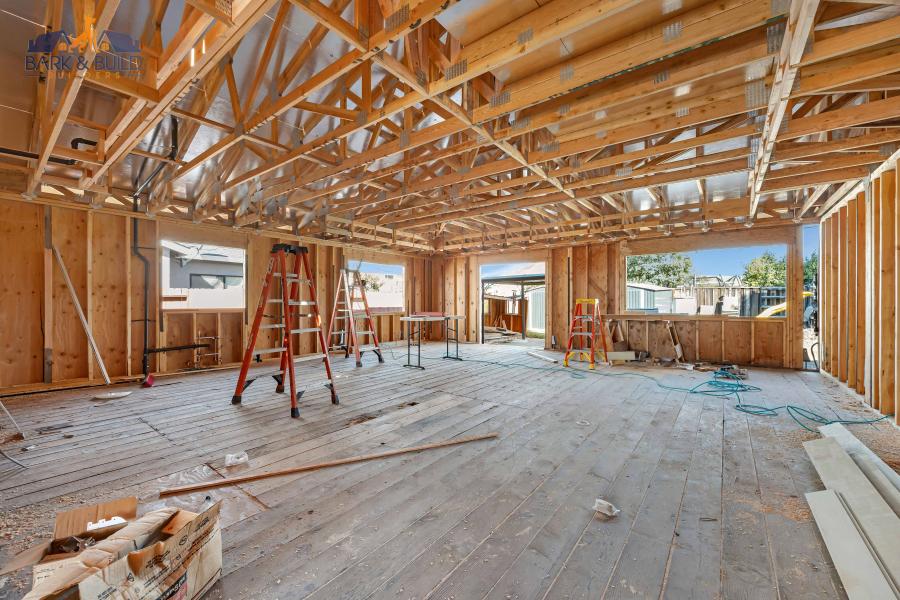
The build sequence: we strip the shared partition wall down to the studs. Inside the wall cavity, we densely pack acoustic mineral wool insulation that physically traps sound waves. We install resilient channels — metal furring strips that decouple the new drywall from the wood framing, breaking the vibration path. Finally, we hang 5/8-inch Type X drywall (also code-required for the fire rating), often with mass-loaded vinyl (MLV) backing on one side.
The practical result: you can host a dinner party in the main house, and the tenant in the JADU experiences quiet. Both parties retain real privacy under the same roof.

Mechanical Separation
Independent HVAC and Electrical — How a Shared Home Becomes Two Functionally Independent Units
A JADU isn't just a wall and a kitchen. It's a mechanically separate unit carved out of a house that was originally engineered as one ecosystem.
Independent HVAC — Ductless Mini-Split Heat Pumps
Sharing forced-air ductwork between the primary home and the JADU isn't just functionally bad — it violates fire code by allowing smoke to travel between units, and it kills acoustic privacy by turning the supply ducts into speaking tubes.
We disconnect and seal off the primary home's ductwork at the JADU partition. For climate control, we install a high-efficiency ductless mini-split heat pump sized for the JADU footprint — typically a 9,000 to 12,000 BTU head unit for a 500 sq ft space. The tenant has full independent control of their own heating and cooling without ever touching the main house's thermostat.
Dedicated Electrical Sub-Panel
For full functional independence, we pull a new dedicated electrical sub-panel feeding the JADU. The tenant's circuits operate completely separately from the primary home — a tripped breaker in the JADU doesn't affect the main house, and load on the JADU side doesn't draw against the primary panel's capacity.
The efficiency kitchen runs on dedicated 120-volt circuits with GFCI protection, sized to handle a plug-in induction cooktop, convection microwave, refrigerator, and small appliances simultaneously. We size the sub-panel feed based on calculated load, not guesswork.
What's Included
What Goes Into Every JADU Conversion We Build
Every JADU Bark & Build delivers is built to function as a fully independent living space — within the 500-square-foot classification that permits it.
JADU Classification Review
Confirm the space qualifies — size, location within existing structure, access configuration. No design fee committed until classification is confirmed.
Efficiency Kitchen Installation
Compact sink, plug-in cooktop, counter space meeting JADU code — sized to maintain JADU classification with no full-size range or hard-wired appliances.
Interior Access Provision
Connecting doorway between JADU and main home installed or retained per local code interpretation.
Independent Exterior Entrance
Private entry constructed or modified to meet egress width, hardware, weather-seal, and pathway lighting standards.
Plumbing Rough-In
Supply and drain connections for the efficiency kitchen and bathroom if included. Layout designed around existing drain stack position.
Dedicated Electrical Scope
Sub-panel feed, dedicated circuits, GFCI protection, lighting and outlet placement per California Electrical Code.
One-Hour Fire-Rated Partition
Type X drywall, mineral wool insulation, resilient channels for sound attenuation. STC 50+ acoustic target.
Independent Mini-Split HVAC
Ductless heat pump sized for footprint. Primary home ductwork sealed off at the partition. No shared air supply.
Waterproofing & Finishes
Bathroom wet-area waterproofing membrane, tile, cabinetry, fixtures, paint, and flooring installation.
Permit Documentation Package
Full permit application, owner-occupancy deed restriction language, and plan set prepared for first-submission accuracy.
How We Execute
How a JADU Conversion Works With Bark & Build
Phase 1 · Week 0
Space Qualification & Classification Review
Site visit. We measure the proposed conversion space, verify it's under the 500 sq ft cap, confirm it's within the main home's existing wall structure, and identify where the existing drain stack exits the floor framing relative to the proposed efficiency kitchen placement — that vertical pipe position determines kitchen layout flexibility. We document current wall openings and determine the interior access provision configuration. No design fee committed until classification is confirmed.
Phase 2 · Weeks 1–14
Permit Preparation & Construction Sequencing
Plan set, owner-occupancy deed restriction documentation, and full permit application assembled and submitted. 6–14 week plan check window. Once permit issues, construction follows a permit-informed trade schedule: framing and structural modifications first, then plumbing rough-in, electrical sub-panel, mini-split HVAC, insulation, sound-attenuating drywall, waterproofing. Primary residence remains occupied throughout.
Phase 3 · Final 2 weeks
Systems Verification & Owner Walkthrough
Every system independently verified before final inspection. Plumbing pressure-tested. Electrical circuits verified. Efficiency kitchen cooktop and sink functional-tested. Exterior entrance hardware, weatherstripping, and threshold checked. Interior access doorway operation verified. We walk the finished space with you before we call for final inspection — so you see the completed unit before the inspector does, and any items requiring adjustment get handled on our timeline.
Investment Range
What a JADU Conversion Costs in San Mateo County
Most junior ADU conversions in San Mateo County range from $60,000 to $180,000. Range depends on whether a private bathroom is included (and whether the slab needs trenching), how much structural modification is required for the interior access provision, and finish level. These are realistic ranges based on completed projects.
Shared Bathroom Model
$60K – $100K
Interior partition wall with sound attenuation. Efficiency kitchen with plug-in induction cooktop. Independent exterior entrance. Ductless mini-split HVAC. Shared bathroom with primary dwelling. Owner-occupancy required.
Independent Bathroom — AB 1154
$100K – $155K
Dedicated private bathroom with slab trenching for new waste line. Full AB 1154 owner-occupancy exemption unlocked. Fire-rated partition wall. Efficiency kitchen. Independent entrance. Electrical sub-panel. Ideal for maximum rental flexibility.
Premium / Multi-Generational
$155K – $180K
Universal design features — curbless shower, accessible kitchen, wide doorways. Premium finishes and custom cabinetry. Murphy bed integration option. Separate electrical meter. Advanced sound attenuation with MLV backing.
All tiers include permits, structural engineering where required, fire-rated assemblies, and municipal inspections. No exterior foundation, roofing, or excavation costs — your existing footprint is the foundation. Final budgets confirmed through a pre-construction feasibility review.
Service Area
Communities We Serve Across San Mateo County
Bark & Build completes junior ADU conversions throughout San Mateo County and the surrounding Peninsula.
In Redwood City, we've worked in neighborhoods along Jefferson Avenue and in the Farm Hill and Friendly Acres areas. In Menlo Park, we're familiar with the permit requirements for properties near the Encinal Avenue corridor and the Allied Arts neighborhood. In San Mateo, we've submitted JADU plans for homes in Baywood and Fiesta Gardens. If your property is in San Mateo County, we have permit familiarity with your local jurisdiction.
Redwood CityMenlo ParkSan MateoFoster CityBelmontSan CarlosMillbraeBurlingameAthertonHillsboroughEast Palo AltoHalf Moon BayDaly City
Common Questions
Frequently Asked Questions on Bay Area Junior ADU Conversions
How much does a JADU conversion typically cost in the Bay Area?
Most junior ADU conversions in the Bay Area range from $60,000 to $180,000, depending on scope. The single biggest cost driver is whether you build a shared bathroom (lower cost, owner-occupancy applies) or an independent bathroom that unlocks the AB 1154 owner-occupancy exemption (higher upfront cost, dual-tenant rental flexibility). Efficiency kitchen plumbing, a private entrance, and structural modifications for the interior access provision also affect the budget. We confirm your space qualifies before any design cost is committed.
How long does a JADU conversion take from first assessment to permit issuance?
A correctly classified JADU submittal typically reaches permit issuance in 6 to 14 weeks in San Mateo County. That timeline assumes complete documentation — including the owner-occupancy deed restriction — is submitted on the first plan check. Missing documents at submission are the most common cause of added weeks. Bark & Build assembles the full documentation package before anything is filed. After permit issuance, construction itself typically runs 8 to 12 weeks depending on bathroom scope.
What exactly is an efficiency kitchen, and will it feel functional to live with?
An efficiency kitchen includes a compact sink, a plug-in cooktop (typically a two-burner induction unit), and counter space — no full-size range or hard-wired dishwasher. It meets JADU code requirements while keeping the unit within the 500-square-foot classification limit. Properly designed, it functions well for everyday cooking — a tenant can run a toaster oven, coffee maker, and induction cooktop simultaneously on the dedicated GFCI circuits. We spec the layout around the existing drain stack position to maximize usable counter and storage space.
Why does the interior access provision catch so many JADU plans by surprise?
State law requires every JADU to maintain a doorway connecting it to the main home — even if the unit has its own exterior entrance. Many plans submitted without this provision are flagged at plan check and sent back for redesign. Bark & Build includes the interior access configuration in the initial design package, not as a revision item.
Can I convert any room in my house into a JADU, or are there restrictions?
The room must be within the existing wall structure of the home and no larger than 500 square feet. Garages and detached structures do not qualify — those follow a different ADU pathway. Bedrooms, dens, and attached interior rooms are the most common qualifying spaces. We confirm eligibility on the first site visit at no cost.
What does Bark & Build handle that a standard design firm wouldn't?
We manage classification, permit documentation, owner-occupancy deed restriction preparation, and full construction under one license — CA #1119304. A design firm typically stops at drawings. That handoff between design and permit submission is where classification errors most often surface — exactly the issue we caught on the Encinal Avenue project. Handling both under one roof means the plans submitted match the permit pathway from the start.
Does building a JADU trigger a property tax reassessment?
No — building a JADU does not trigger a full property tax reassessment of your primary residence under Proposition 13. The San Mateo County Assessor will assess the value of the newly created interior conversion as "new construction" and add it to your existing tax base. Your primary dwelling's original assessed value remains protected.
Are off-street parking spaces required for a JADU in Redwood City?
No — California state law and Redwood City ordinances prohibit municipalities from requiring replacement or additional off-street parking for a JADU. Because the maximum 500-square-foot unit is carved entirely from your existing home's footprint, you don't need to pour a new driveway or sacrifice landscaping for tenant parking.
How does AB 1154 actually change my rental flexibility?
Before AB 1154, every JADU required the property owner to live on-site in either the primary home or the JADU. AB 1154, in effect from 2026, exempts JADUs with their own independent bathroom from that requirement. The practical result: with a private bathroom in your JADU, you can rent both the primary residence and the JADU to different tenants and live elsewhere yourself. With a shared bathroom, owner-occupancy still applies. The bathroom decision is therefore as much a regulatory decision as a comfort one.
Start Your JADU Project
Ready to Convert That Room Into a Permitted JADU?
A junior ADU conversion starts with one question: does your space qualify? We answer that on the first visit — free, no commitment required. Bark & Build handles the classification, the permit documentation, and the full conversion build under CA License #1119304.